What matters in a warehouse
In warehouses and production halls a vehicle drives through narrow aisles, past racking and close up to pallets, load carriers and people. That defines what the LiDAR has to do:
- Close range: Pallets, fork tines and rack uprights are often only centimetres from the vehicle. The minimum distance decides whether the sensor still sees them.
- Vertical field of view: Overhanging loads, rack beams and protruding goods do not sit in a single scan plane. A 3D LiDAR sees them — how much of them depends on the vertical angle.
- Range on dark surfaces: For aisles and hall floors, the figure at 10% reflectivity is what counts, not the maximum.
- Power and interface: The voltage has to match the on-board supply, data arrives over Ethernet, and vehicles often carry several sensors.
- Environment: Dust, splash water and cold. The MID-360 S and Mid-70 are rated IP67, and Hesai states IPX7 for the JT128; for freezer areas, check the operating temperature.
Which LiDAR for AMRs and forklifts?
| Feature | 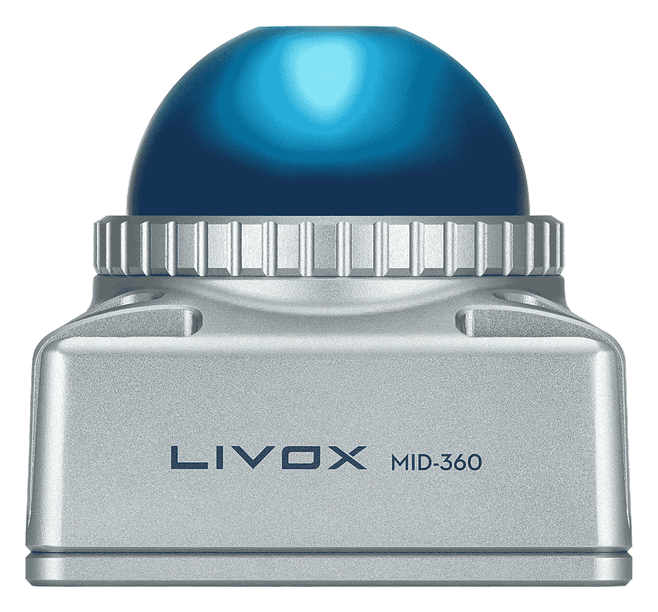 Livox MID-360 Snavigation and localisation |
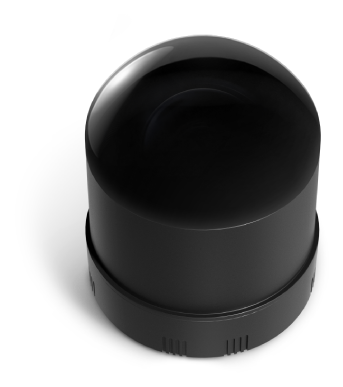 Hesai JT128bottom or side connector |
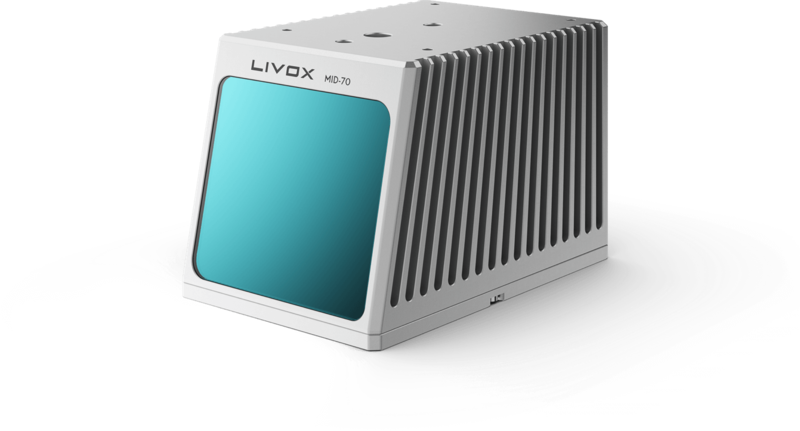 Livox Mid-70close range in front of the vehicle |
|---|---|---|---|
| Role on the vehicle | navigation, mapping, obstacle detection | all-around capture without blind spots | close range, docking, low speed |
| Field of view (H×V) | 360° × 59° | 360° × 189° | 70.4° circular |
| Close range | 0.1 m minimum distance | close-range obstacle detection | 0.05 m minimum distance |
| Range @ 10% | 40 m (typical) | 40 m (max. 60 m) | 90 m |
| Point rate | 200,000 pts/s | up to 1,152,000 pts/s | 100,000 pts/s |
| Connection | Ethernet (100BASE-TX) | cable exit at the bottom or side | Ethernet (100BASE-TX), Livox Converter 2.0 |
| Weight | 265 g | 265 g | approx. 580 g |
| Ingress protection | IP67 | IPX7 (per Hesai) | IP67 (excluding converter and cables) |
| Price (net) | €605 | €1,100 (both versions) | €1,042 |
| Availability | in stock | in stock | limited stock |
| Buy the Livox MID-360 S → | Bottom connector → Side connector → | Buy the Livox Mid-70 → |
Prices net, plus 19% German VAT and shipping. Specifications as stated by the manufacturer and listed on our product pages. As of November 2026.
Livox MID-360 S — the navigation sensor
The MID-360 S sees 360° around and 59° vertically. In long, uniform aisles the full all-around view helps localisation, because structures to the side and behind the vehicle also go into the map. The built-in IMU supports LiDAR-inertial odometry, and the 0.1 m minimum distance covers close range. At 9–27 V DC and 6.5 W it runs directly on a 24 V on-board supply.
Hesai JT128 — a hemisphere for forklifts and superstructures
With 360° × 189°, 128 channels and up to 1,152,000 points per second, the JT128 captures its surroundings with practically no blind spot, including thin objects and low-reflectivity surfaces. At 265 g and Ø 62.5 × 73 mm it also fits tight installation spaces. We stock both connector versions: the Hesai JT128 with bottom connector for mast or bracket mounting with a cable feed-through, and the Hesai JT128 with side connector for flat installations with little height. Sensor, data and price are identical.
Livox Mid-70 — a direct view in front of the vehicle
With its 70.4° circular field of view, the Mid-70 detects objects from 5 cm away — for example as a forward-facing auxiliary sensor at docking and transfer points or on low-speed vehicles. It runs on 10–15 V DC, or on 9–30 V DC through the Livox Converter 2.0, and is rated for −20 °C to +65 °C. We still have limited remaining stock; for new series vehicles we recommend the MID-360 S.
Integrating LiDAR for AMRs and forklifts in practice
Several sensors on one vehicle
The Livox driver livox_ros_driver2 reads IP addresses and ports from a JSON configuration file, where you list several LiDARs together. With the multi_topic parameter each sensor can publish its own ROS topic. The JT128 is integrated with Hesai's HesaiLidar_ROS_2.0, the Mid-70 with livox_ros_driver or livox_ros2_driver. Fusing the point clouds is the job of your navigation stack.
Power from the vehicle battery
With 9–27 V DC, the MID-360 S suits 24 V systems. On 48 V or 80 V batteries you need a DC/DC converter to a suitable voltage. For the Mid-70, Livox provides the Converter 2.0.
Mounting and testing with real load carriers
Mount the sensor rigidly and so that forks, mast and load block as little of the field of view as possible; mask whatever remains in software. Test detection with your actual load carriers: stretch film, dark plastics and glossy surfaces reflect very differently.
Design the safety function separately
We offer the sensors shown here as perception sensors for navigation, mapping and obstacle detection, not as safety sensors. For personnel protection on driverless vehicles, use a certified safety laser scanner; the 3D LiDAR complements it.