What matters in a SLAM LiDAR
A SLAM sensor has to capture the surroundings well enough for the robot to localise itself reliably while it builds a map. Peak range rarely decides the matter. These points do:
- Field of view: 360° horizontally gives the localisation features in every direction. The vertical angle decides whether the floor, the ceiling and overhanging obstacles are in view.
- Minimum distance: How close can an object get before the sensor stops seeing it? In narrow aisles and when docking, every centimetre counts.
- Range at 10% reflectivity: The meaningful figure for dark, low-reflectivity surfaces — more telling than the maximum at 80%.
- Built-in IMU: LiDAR-inertial odometry such as FAST-LIO fuses the point cloud with inertial data. An integrated IMU makes that sensor fusion simpler.
- Interface, power, weight: Ethernet, a supply voltage that matches the on-board power and a few hundred grams make integration on small platforms easier.
- Driver: A ROS/ROS2 driver maintained by the manufacturer is what gets you to a first point cloud quickly.
- Ingress protection: Outdoor robots need a dust- and watertight housing; the MID-360 S and Mid-70 are rated IP67, and Hesai states IPX7 for the JT128.
Which LiDAR for robotics and SLAM?
Three sensors from our range cover the typical robotics scenarios:
| Feature | 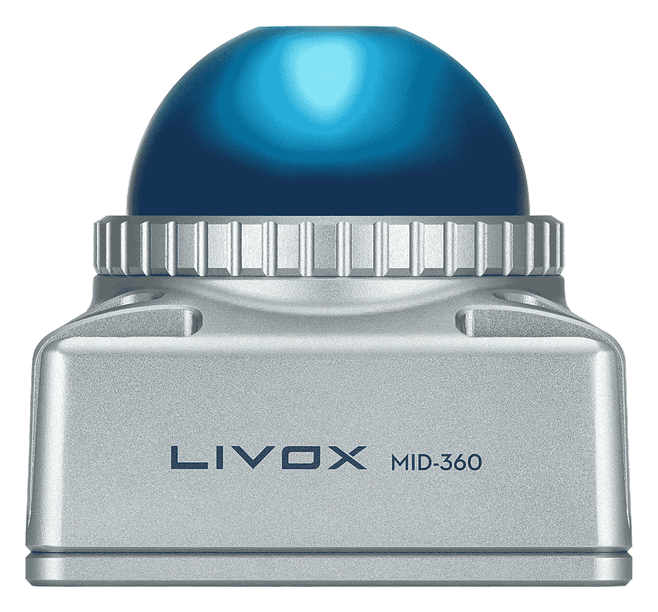 Livox MID-360 S360° LiDAR for robotics |
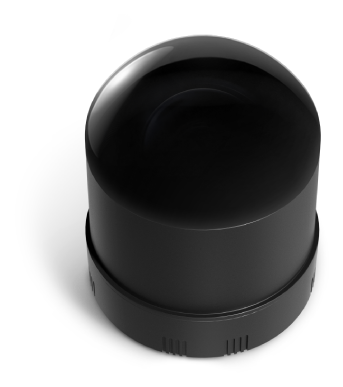 Hesai JT128bottom or side connector |
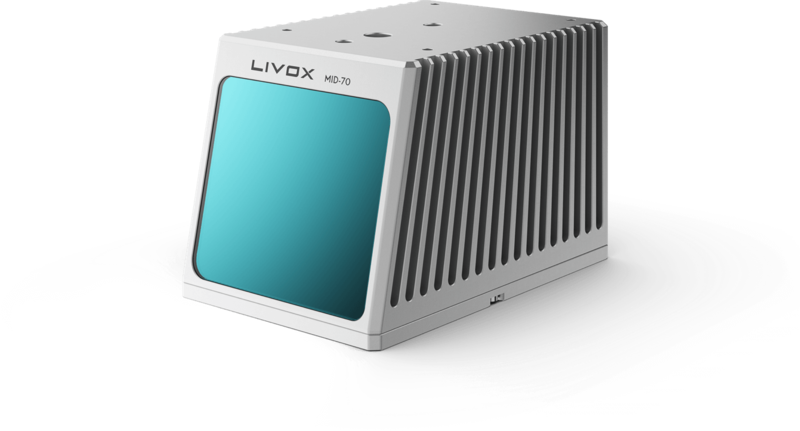 Livox Mid-70close range from 5 cm |
|---|---|---|---|
| Typical task | SLAM, navigation, AMRs | dense all-around capture without blind spots | close range, low-speed autonomy |
| Field of view (H×V) | 360° × 59° | 360° × 189° | 70.4° circular |
| Range | 40 m @ 10% (typical), 100 m cut-off range | 40 m @ 10% (max. 60 m) | 90 m @ 10% / 260 m @ 80% |
| Point rate | 200,000 pts/s | up to 1,152,000 pts/s | 100,000 pts/s (200,000 dual return) |
| Highlight | built-in IMU, 0.1 m minimum distance | 128 channels | 0.05 m minimum distance |
| Weight | 265 g | 265 g | approx. 580 g |
| Ingress protection | IP67 | IPX7 (per Hesai) | IP67 (excluding converter and cables) |
| ROS driver | livox_ros_driver2 | HesaiLidar_ROS_2.0 | livox_ros_driver / livox_ros2_driver |
| Price (net) | €605 | €1,100 | €1,042 |
| Availability | in stock | in stock | limited stock |
| Buy the Livox MID-360 S → | Bottom connector → Side connector → | Buy the Livox Mid-70 → |
Prices net, plus 19% German VAT and shipping. Specifications as stated by the manufacturer and listed on our product pages. As of November 2026.
Livox MID-360 S — the SLAM standard
The MID-360 S combines a 360° × 59° field of view, a 0.1 m minimum distance and a built-in IMU in 265 g. Point cloud and IMU data share a single Ethernet cable (100BASE-TX). It runs on 9–27 V DC at 6.5 W, which suits common 12 V and 24 V on-board systems. With a 10 Hz frame rate, IP67 and an operating range of −20 °C to +55 °C, it is built for indoor and outdoor robots alike.
Hesai JT128 — when one sensor has to see everything
128 channels, 360° × 189° and up to 1,152,000 points per second: the JT128 captures its surroundings with practically no blind spot, including thin objects and low-reflectivity surfaces. At 265 g and Ø 62.5 × 73 mm it fits into tight spaces. Its range of 40 m at 10% (max. 60 m) is designed for close-range work. The sensor comes with the cable exiting at the bottom or at the side.
Livox Mid-70 — close range from 5 cm
With a 70.4° circular field of view and a 0.05 m minimum distance, the Mid-70 sees what is directly in front of the robot, for example as a forward-facing auxiliary sensor. It is powered through the Livox Converter 2.0 (9–30 V DC). We still have limited remaining stock of original new units; for new series projects we recommend the MID-360 S.
Integrating LiDAR for robotics and SLAM in practice
Drivers and SDK
For the MID-360 S, Livox publishes the livox_ros_driver2 driver on GitHub. It builds on Livox-SDK2 and, according to the project documentation, runs on ROS Noetic and ROS 2 Foxy, Humble and Jazzy. The MID-360 S has its own launch files (rviz_MID360s, msg_MID360s); IP addresses and ports live in a JSON configuration file, which can also list several LiDARs at once. The Mid-70 belongs to the older Livox generation: it uses the Livox SDK together with livox_ros_driver (ROS 1) or livox_ros2_driver (ROS 2). For the JT128, Hesai offers HesaiLidar_ROS_2.0, built on HesaiLidar_SDK_2.0 and supporting ROS 1 and ROS 2.
FAST-LIO and other SLAM frameworks
The widely used FAST-LIO framework ships a ready-made configuration for the MID-360 (mid360.yaml, mapping_mid360.launch), and its ROS 2 branch builds directly on livox_ros_driver2. According to the FAST-LIO documentation, the framework expects Livox's own message format (CustomMsg) with a timestamp per point. So start the driver with the msg_… launch file rather than the rviz_… variant. FAST-LIO also lists the Avia and the Mid-70 as supported sensors.
Mounting
Give the sensor a clear view. Anything inside the field of view — housing parts, cables, superstructures — shows up in the point cloud and has to be filtered out in software, in FAST-LIO for example through a minimum distance (the blind parameter). On the MID-360 S, mounting height and tilt decide which part of the 59° vertical coverage falls on the floor and on obstacles. Mount the sensor rigidly to the frame: the built-in IMU measures the motion of the sensor, not of the robot, and a vibrating bracket distorts the odometry.